It happened on a rainy Tuesday night in Columbus, Ohio, the kind of night when the wind rattles windows like a warning. I was heading home from the hospital, exhausted from a double shift. I was thirty four, newly divorced, and so tired that life felt like a long hallway with no doors. Even so, that cry stopped me before my apartment door.
A baby. Wrapped in a thin blue blanket. Left in the dim hallway like a forgotten package. His cheeks were red from crying, his breaths sharp and frightened. I dropped my keys, knelt, and touched his cheek. Warm. Real. Terribly real.
I knocked on doors. Apartment after apartment. No answer. No note. No diaper bag. Nothing except a newborn and the storm outside.
I called the police. They came, took statements, shrugged in ways they probably did not mean to, and left. Child services followed. More questions. More forms. The baby became a case file labeled Infant Doe, a placeholder for a life just beginning.
Days became weeks. I kept checking in. I worked night shifts at Riverside General Hospital. I scrubbed my hands raw. I stayed late to help new parents learn how to hold their newborns. And each morning on my way home, I found myself thinking about the baby with the blue blanket.
Then one afternoon, child services called.
“Ms. Renee Whitman, due to an overflow in placements, would you consider temporary foster care?”
My heart answered before my mouth did. I said, “Yes, of course. Yes.”
He came back to me with a tiny onesie and a folder full of medical records. Temporary became routine. Routine became love.
I named him Grayson. Life stretched and reformed around him. I moved from nights to days, even though it meant losing the promotion I had been fighting toward. My bank account shrank. My patience expanded. Friends drifted away. My parents shook their heads but showed up every Christmas with toys.
Grayson learned how to crawl across the living room carpet, sunlight in his hair. He learned how to read with his head on my lap. He learned that mistakes were not sins but stepping stones. He learned that he was wanted.
He called me Mom before he knew what the word meant. By the time he did, he never used anything else. I told him the truth gently. I told him that someone else had given him life, but I stayed. I told him being chosen can happen more than once in a lifetime. He accepted it with a quiet confidence.
Seventeen years passed. Then the knock came. A man in a dark suit. Polished shoes. The raincoat of someone who had never rushed for a bus in his life. He handed me legal documents. A name I did not recognize stared up at me.
Valerie Sutton. His biological mother.
A woman who built a tech empire in Seattle. Founder of a start up sold for millions. Recently widowed. She wanted to reclaim the child she left in a hallway nearly two decades ago.
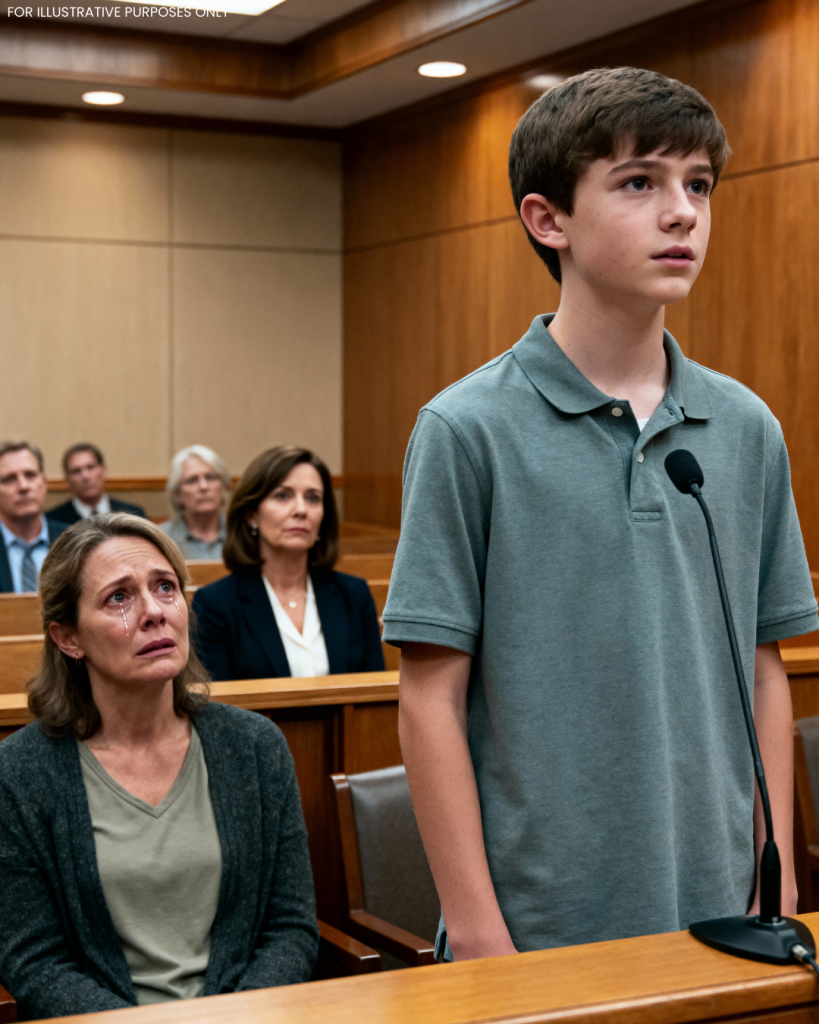
I sat in a courtroom three weeks later. The flags loomed behind the judge like stern sentinels. My hands shook. Grayson sat beside me, jaw clenched.
Valerie entered like someone used to bright lights. Perfect posture. Diamond earrings. Lawyers flanking her like a fortress.
She said she had been young and scared. She said she never meant to abandon him permanently. She said her new stability made room for him now. She talked of colleges, influence, and legacy.
The judge listened. Then turned to Grayson. “Son, at seventeen years old, your voice carries legal weight. Is there anything you would like to say before I make a decision?”
The courtroom hushed. Grayson rose slowly. He did not look at Valerie at first. He looked at the judge.
“I know she is my mother biologically. I have known that my whole life.”
Valerie’s eyes glimmered with hope.
“But blood is not the thing that sat with me when I had pneumonia. Blood is not what learned to braid my hair for picture day because Mom was crying in the bathroom after her divorce. Blood is not what helped me fill out college applications at two in the morning with cold pizza and pep talks. Blood did not stay.”
His voice wavered, but his spine did not.
He turned to Valerie. His eyes were steady. “I do not hate you. I am thankful for my life. But I do not want to be claimed like property because I suddenly matter. I do not want to trade the woman who raised me for a stranger with resources.”
Gasps fluttered through the crowd. Valerie reached forward. The judge raised a hand. Silence returned.
Grayson continued. “I want to meet her. I just do not want to lose the woman who already feels like home.”
The judge nodded slowly. The ruling did not come that day. Courtrooms are slow machines. Instead, the judge ordered mediation. Counseling. Negotiated visiting schedules. The court recognized Valerie’s parental rights, but they did not override mine. Custody remained where it had been for seventeen years.
The press swarmed outside. Flashbulbs burst around us. Someone asked Valerie how she felt.
She said, “Hopeful.”
Someone asked Grayson the same question. He said nothing.
At home that night, the house felt too quiet. The rain pattered outside again, like a loop closing. Grayson sat on the couch, elbows on knees.
“Mom,” he asked without looking up, “would you hate me if I tried to get to know her?”
My throat tightened. I thought of the hallway. The blue blanket. The years I held him through fear and fevers and heartbreak.
I said, “No. I just want you to stay rooted in what is real.”
He nodded. The next months were a strange balancing act. Valerie invited him to brunches at expensive restaurants in Seattle. He declined the private flights she offered, choosing economy seats instead. He sat across from her in glass walled offices while she spoke about opportunities.
He asked questions she did not expect.
“Why did you wait this long?”
“Why now?”
“Do you want me or the idea of me?”

Sometimes she answered with tears. Sometimes with silence. He came home from the first meeting and curled up on the couch beside me, staring at the ceiling.
“She is trying. It just feels like she is trying for a version of me that exists only in her imagination.”
Relationships rarely move in a straight line. They zigzag. They collide. They retreat.
Three months later, the court finalized the arrangement. Valerie’s rights acknowledged. Custody unchanged. Grayson allowed autonomy. The judge recommended a relationship, not a replacement. It felt fair in theory. In practice, it hurt.
Valerie cried in the courtroom. Not performatively. Not for cameras. Quietly. Like someone mourning a door she could not reopen.
Grayson hugged her before we left. My breath caught at the sight. Life did not become perfect after that. Therapy sessions became monthly. Holidays became negotiations. Valerie sent birthday checks. Grayson sent thank you cards instead of acceptance.
He chose boundaries. He chose balance. He chose me, too. Not exclusively. Not defensively. Simply because love, once earned, leaves fingerprints that never fade.
Years from that first knock, I watched him pack for college. He stood in the kitchen, taller than the doorframe, shoulders steadier than mine had ever been at his age.
“Mom,” he said, stuffing clothes into a duffel bag, “I am not choosing between you and her anymore. I am choosing myself. I just hope that is enough for both of you.”
I stepped forward and straightened his collar. “It always was.”
He is eighteen now. He visits Valerie sometimes. Sometimes they argue. Sometimes they sit in silence and let the years between them speak. He sends her photos of sunsets from campus. He sends me videos of squirrels stealing snacks outside his dorm.
He belongs to the world in ways I never saw coming. He belongs to himself. I am learning to let that be enough. People ask if I was afraid of losing him. I was. Terrified. But motherhood is not measured by possession. It is measured by presence. By the nights you stay even when you are scared. By the mornings you greet with empty hands and still offer love.
If you stood where I stood, would you fight harder? Would you let go sooner? Would you trust a bond built through seventeen years of scraped knees and late night fevers? If you were Grayson, would you walk toward the mother who returned or cling to the mother who stayed?
There is no simple answer. Family is not always who starts the journey with you. Sometimes it is who waits on the path. Who holds a light when the way back seems impossible. Who stays.