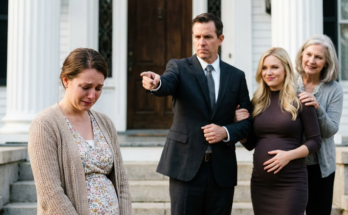
The night they threw him out, they wouldn’t even let him explain. The ex-Marine—because in Mexico he was no longer “The Marine,” just Gael Navarro, a tired man holding two children by the hand—was standing on the porch with the backpacks of his twins, Mateo and Mia, when his father-in-law threw the last bag onto the ground as if it were trash.
“That’s it, Gael,” spat Don Ramiro Salgado, with the voice of a man who believes he is in charge simply because he shouts. “You’re broke. You bring nothing to this family. And those kids aren’t our problem. Get out.”
The twins were crying, confused, clinging to his legs. His mother-in-law, Doña Lidia, didn’t even look at them. She just crossed her arms as if their crying were merely an annoying noise.
“We gave you a roof for too long,” she said. “My daughter deserves better.”
“My daughter” was Renata, his wife… or what was left of her. Renata stood behind the door, wearing the coldest smile Gael had ever seen. She didn’t say “no,” she didn’t say “stop.” She just let her parents do the dirty work. And when Gael tried to speak, the slamming of the door cut off everything.

There, standing on the dirt of the driveway, with dust clinging to his shoes, Gael felt something he had never felt in war: total helplessness. Because surviving fear on the battlefield is one thing… watching your children tremble because the world has suddenly slammed the door in their faces is another.
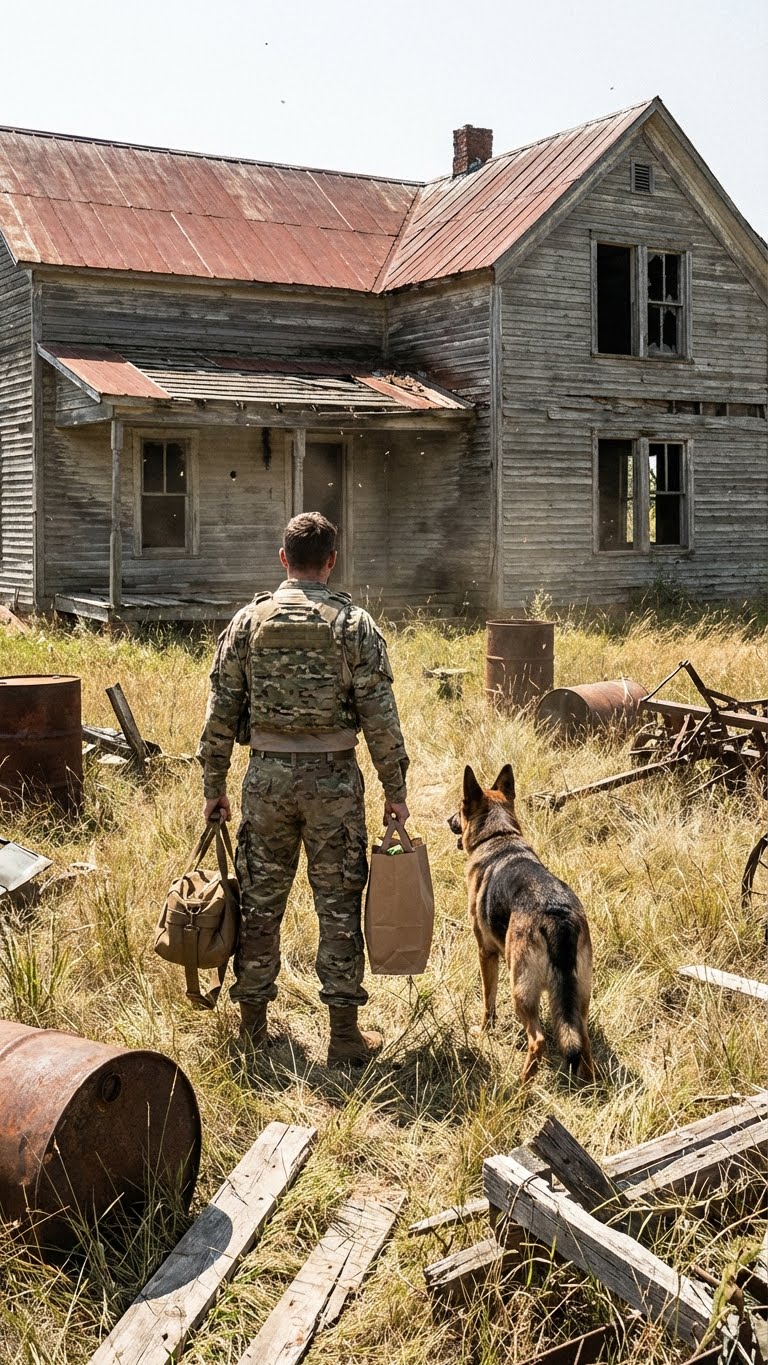
By his side was Rayo, his K9 dog, a Belgian Malinois with a serious gaze. He didn’t bark. He didn’t go crazy. He simply placed himself one step in front of the children, like a living wall.
“Calm down,” whispered Gael, wiping away tears with his thumb. “I’m here. Everything is okay.”
But it wasn’t. Everything was happening.
The gas tank was almost empty. Night was falling fast. The twins had gone hoarse from crying so much. Gael drove aimlessly until the paved road turned to dirt, and the city, with its lights, was left behind.
At the end of a forgotten stretch of road, a silhouette appeared: an old house with a sagging porch and dark windows. A huge plot of land filled with weeds, broken fences, and a barn that had nearly collapsed.
People called it “The Dump.” “The Cursed Land.” “Pure Loss.” But Gael knew it by another name: El Potrero de Don Tomás (Don Tomás’s Paddock). The property had belonged to his grandfather, a man of few words and strong hands who died leaving no inheritance other than an old photo and a rusty key.
Gael parked. He got out. The air smelled of wet earth and dead wood.
“Are we going to sleep here?” asked Mia, her little voice shattered.
Gael swallowed hard. “Just for tonight, my love. Tomorrow… tomorrow we’ll see.”
He didn’t want to lie to them with pretty words. He couldn’t.
Inside, the house was dust and silence. The floorboards creaked as if complaining. Gael spread out some blankets on the floor, made a makeshift bed with their jackets, and gave the children the last things he had: a broken cookie and water in a bottle. The twins hugged each other, as if their small bodies were the only safe things left.
When they finally fell asleep, Gael let himself slide down against the wall, exhausted. And then, Rayo started acting strange.
The dog walked in circles, sniffing the floor, the corners, the walls, as if the house were speaking in a secret language. Then he went outside and stared toward the barn.
“What is it, buddy?” Gael murmured in a tired voice. “There’s nothing here.”
Rayo ignored him. He lowered his snout and let out a low, concentrated growl. It wasn’t aggressive; it was alert. Working mode. Gael felt that old soldier’s instinct awaken. In war, you learn to trust what you cannot see.
The next morning, a pale ray of light entered through the broken windows. The twins were still asleep when Rayo sprang up like a spring and ran to the barn, barking in short, dry bursts.
Gael went out after him, stepping on wet grass. The dog stopped near a corner of the foundation, pressed his snout to the dirt, and started to dig. It wasn’t a game. It was a direct attack on the ground—fast, precise, as if he knew exactly where.
“Rayo, easy!” Gael crouched down. “What did you find?”
Claws scraped against something hard. Metal. Gael dug his hands in, pushed aside the earth, and pulled out a heavy, rusted container sealed with bolts. It wasn’t trash. It wasn’t scrap metal. It was… intentional.
He wiped the mud from the lid and froze. Etched there, almost faded, were initials: T.N. And to the side, an old bank symbol, like a shield.
“Grandpa…” whispered Gael, with a brutal thumping in his throat. “What did you hide here?”
He managed to open it with an old crowbar. Inside were thick envelopes wrapped in oiled cloth, yellowed papers, and a leather folder with dates and stamps. Gael opened the first document and read words he never thought he’d see in his life:
Trust. Mineral Rights. Access to Seams. Participation in Extraction. Beneficiary: Gael Navarro.
His lips went dry. He kept reading. Estimated value of assets linked to the land: $200 million USD.
Gael sat on the dirt as if the air had been knocked out of him. He looked at the field everyone called useless. The twisted barn. The fallen house. And he understood: it wasn’t abandonment. It was camouflage.
Rayo sat beside him, proud, as if to say: “I told you so.”
The twins came running out when they heard the noise. “What happened, Daddy?” asked Mateo, his hair messy from sleep.
Gael looked at them, and his voice broke for the first time since the door had been slammed in his face. “What happened… is that we aren’t alone,” he said. “What happened is that your great-grandfather left us… a way out.”
He didn’t explain the numbers. He just hugged them tight, as if that hug could hold all the fear of the previous night.
That same day, with his old cell phone, Gael called the only number he remembered by heart: Susana Ibarra, a lawyer who was a friend of his grandfather. When he mentioned the address of the Paddock, there was silence on the other end.
“Gael… listen to me closely,” the woman said, suddenly serious. “Don’t let anyone in. Don’t tell anyone. Not even your in-laws. Do you hear me?”
“Why?” he asked, his heart already in his throat.
“Because that land… isn’t just any land. Your grandfather put it in sealed trusts. And if they find out… they’ll want to eat you alive.”
Three hours later, a black SUV kicked up dust on the road. Susana arrived with a briefcase and a face that said, “This can’t be true.” She reviewed documents, verified seals, made calls. Finally, she looked up slowly.
“Your grandfather was smarter than everyone thought,” she said. “These mineral rights and access points… are worth at least 200 million. And they are legally bound to you. No one can touch them.”
Gael felt the world tilt. “All my life they told me this place was trash…”
Susana nodded. “Exactly. And that’s why it survived intact.”
That night, for the first time in days, the twins laughed inside the house while eating canned beans heated on a burner. Gael listened to them laugh as if it were a small miracle, bigger than the money.
At that moment, his cell phone rang. “Renata” on the screen.
Gael went out to the porch. Rayo followed him and sat next to him, like a guard. “Hello?” Gael answered without emotion.
His father-in-law’s voice came first, too kind to be real. “Gael… son… look, about yesterday… it was a misunderstanding. We didn’t know…”
Then Doña Lidia chimed in, forcing tenderness: “We are family. The children… the children matter to us.”
Gael clenched his jaw. He remembered the bags in the dirt. The crying. The slam of the door. The laughter inside.
“You guys did know something,” he said slowly. “You knew I had two children. You knew I had nowhere to go. And even so, you threw us out like animals.”
Silence.
“We can talk,” insisted Don Ramiro. “Fix this. Come back, bring the kids. You have a home here.”
Gael looked inside. He saw Mateo and Mia playing with Rayo, calm for the first time. He saw a makeshift lamp. He saw peace being born in a place everyone had despised.
“There is nothing to fix,” he said. “I’m not going to seek revenge… but I’m not going to forget either.”
He hung up.
Rayo stood up, placing himself between the porch and the road, staring into the darkness as if he knew that some doors, when closed, must stay closed.
Months passed. The Paddock stopped being a ruin. The porch got new wood. The windows shone. The barn was reinforced. A small extra room was built for the twins, with walls painted light blue. The money arrived, yes: accounts, trusts, contracts. But Gael didn’t change.
He got up early. He fixed things with his hands. He taught his children to say “thank you,” to look people in the eye, and never to mock those who are down. And above all, he taught them this:
“Dignity is not negotiable,” he would tell them. “Not for a roof, not for a last name, not for money.”
Susana helped him create a plan. Gael didn’t buy luxury cars. He didn’t go off to show off. He did something his grandfather, in silence, would have approved of: He opened a support program for homeless veterans. Scholarships for children of military personnel. A fund for therapy for families who had lost someone in service.
In the barn, he placed a simple plaque, without big names: “Found by loyalty.”
Because the first one to sense the truth wasn’t a banker or a lawyer. It was Rayo.
And one sunset, while the sun fell over the field and the twins ran with their knees full of dirt, Gael sat on the porch with warm coffee in his hand. The children hung around his neck.
“Daddy,” said Mia, “are we never going back to that house?”
Gael looked at the horizon. He thought of the door slamming shut. And then he looked at his new house, the one he was building with calm, with honor, with real love.
“No, my life,” he replied. “That door closed. But look… another one opened here.”
Rayo settled at his feet, alert, faithful, calm. Gael understood that they had lost everything once… and they had gained something greater. Not just money. Peace. A future. And a home that no one could ever take away from them again.